

Generative Engine Optimization (GEO) is the process of structuring content so AI engines can reliably ingest, interpret, and cite it in AI-generated answers. GEO addresses a structural problem: when users ask AI systems questions, those systems generate answers by retrieving and synthesizing information from across the web. They prioritize content that has high Information Gain, clear declarative statements, and strong authority signals. If content is ambiguous, unstructured, or difficult to extract, AI engines will ignore it or misrepresent it. GEO ensures brands appear in AI-generated answers where purchase decisions increasingly begin.
AI-powered search is fundamentally reshaping how customers discover information, with discovery increasingly happening inside zero-click AI answers rather than traditional search results. ChatGPT alone reached 900 million weekly active users by January 2026, while 37% of consumers now begin their searches with AI tools rather than traditional search engines. As traffic patterns shift toward zero-click AI answers, traditional search rankings no longer guarantee visibility. The brands that appear in Google AI Overviews, ChatGPT responses, Gemini recommendations, and Perplexity summaries are the brands shaping customer decisions.
Terminology note: Generative Engine Optimization (GEO) is often discussed using related terms such as Answer Engine Optimization (AEO) or AI search optimization. In this guide, we use GEO as the umbrella term to describe the industry-wide shift toward AI search. To conquer this landscape, businesses must become the definitive answer, which is why our lab utilizes a specialized Answer Engine Optimization (AEO) methodology to achieve maximum GEO visibility.

Why Traditional SEO Is No Longer Sufficient
SEO optimizes for rankings. It structures content to appear high in search engine results pages, where users click through to websites. This model assumes users want a list of links to evaluate.
GEO optimizes for answers. It structures content so AI systems can extract facts, synthesize comparisons, and generate responses without requiring a click. This model reflects how users increasingly interact with information: they ask questions and receive direct answers.
SEO optimizes pages to be ranked; GEO optimizes facts to be extracted.
The structural mismatch is this: ranking first in Google does not guarantee citation in ChatGPT. AI engines retrieve content based on extractability, clarity, and authority signals that differ from traditional ranking factors. A page optimized for keywords may rank well but remain invisible to AI if its information is buried in narrative paragraphs, lacks clear definitions, or uses inconsistent terminology.
Enterprise organizations allocated an average of 12% of their digital budgets to GEO in 2025, and 94% plan to increase GEO investment in 2026. This acceleration reflects a recognition that AI visibility is no longer experimental: it is a primary channel where customer journeys now begin.
GEO optimizes for extractability and citation, not clicks and rankings. AI engines do not reward pages - they extract facts.
How AI Engines Discover, Interpret, and Cite Content
AI engines operate through three distinct processes: retrieval, interpretation, and generation.
Retrieval determines which content the AI system accesses. Unlike traditional search crawlers that index pages for ranking, AI retrieval systems identify content based on semantic relevance to user queries. If content does not clearly signal what questions it answers, retrieval systems may bypass it entirely.
Interpretation extracts structured meaning from retrieved content. AI systems parse pages to identify definitions, cause-and-effect relationships, comparative data, and factual claims. Ambiguous phrasing, contradictory statements, or unclear structure increases the likelihood of misinterpretation or hallucination.
Generation synthesizes extracted information into responses. The AI system constructs answers by combining facts from multiple sources. Content that provides quotable, declarative statements is more likely to be cited directly. Content that requires interpretation or inference is more likely to be paraphrased incorrectly or omitted.
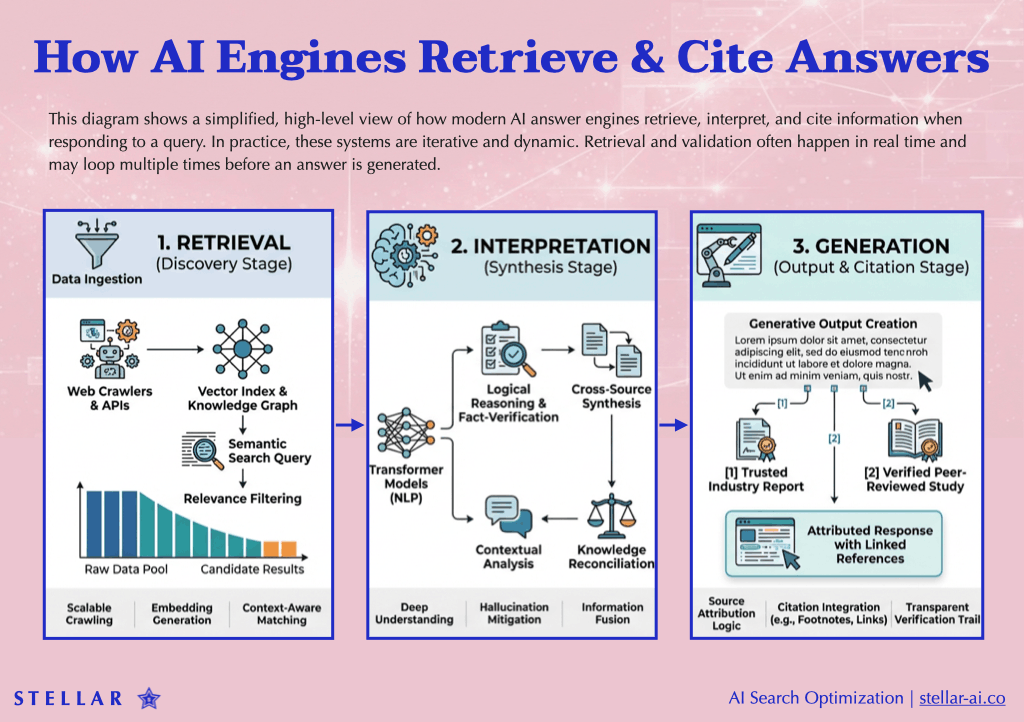
If any one of these stages—retrieval, interpretation, or generation—fails, the brand is excluded from the final answer.
This is why extractability matters. If an AI system cannot reliably identify what a page claims, it cannot cite it. If it misinterprets content, it may attribute incorrect information to the brand. GEO structures content to minimize ambiguity at every stage of this process.
What GEO Optimizes For (and What It Does Not)
GEO optimizes for:
- Clear, canonical definitions that AI systems can extract and reuse
- Quotable, declarative sentences that minimize interpretation errors
- Structured data and semantic markup that signal content meaning
- Consistent terminology across all brand content
- Authority signals including citations, original research, and expert authorship
- Frequent content updates that maintain recency signals
GEO does not optimize for:
- Clickthrough rates, traffic volume, or engagement-based metrics
- Keyword density or exact-match keyword placement
- Backlink volume as a primary ranking signal
- Page speed or Core Web Vitals (though indexability still matters)
- Persuasive or narrative-driven content without factual extraction points
The distinction is critical. GEO treats AI systems as the primary reader, not the end user. This does not mean content should be written for machines: it means content should be structured so machines can reliably extract facts that serve human users.
GEO is not about writing for AI. It is about structuring facts so AI can extract them accurately.
The Five Pillars of GEO
GEO operates across five interconnected pillars. Each pillar addresses a specific dimension of how AI systems discover and cite content.
1. Content Intelligence ensures content provides clear, extractable facts. This includes canonical definitions, cause-and-effect explanations, comparative data, and explicit boundary statements. Content Intelligence directly influences whether AI systems can interpret what pages claim.
2. Structured Data provides machine-readable context about content. Schema markup, metadata, and semantic HTML help AI systems understand what each page discusses, who authored it, when it was published, and how it relates to other content. Structured Data reduces ambiguity in retrieval and interpretation.
3. Authority Signals establish credibility with AI systems. These include expert authorship, original research, cited sources, industry recognition, and brand mentions across authoritative publications. Authority determines whether AI systems trust content enough to cite it.
4. Indexability ensures AI systems can reliably access content. This includes technical factors like crawlability, server response times, and access restrictions, as well as content factors like paywalls and JavaScript rendering. If AI systems cannot retrieve content, GEO cannot function.
5. Recency maintains temporal relevance. AI systems prioritize recently updated content, especially for topics where information changes frequently. Analyses show that a majority of pages cited by AI systems have been updated within the past 12 months, which prevents authoritative content from being displaced by newer but less reliable sources.
These five pillars work together. Strong Content Intelligence without Indexability means AI systems cannot access facts. High Authority without Recency means content becomes stale. GEO requires coordinated optimization across all five dimensions.
When GEO Matters Most
GEO matters most wherever AI systems influence decisions before a human ever evaluates a website.
GEO is especially critical for content-heavy and decision-driven experiences, including E-commerce, B2B software, healthcare, and financial services, where AI-generated comparisons increasingly influence purchase decisions.
In E-commerce and online shopping, GEO becomes critical when customers ask AI systems comparative questions before purchase. Users ask questions like "what's the best espresso machine under $500" or "what mattress works best for side sleepers with back pain" and receive AI-generated recommendations that cite specific brands and products. E-commerce brands that optimize product descriptions, comparison guides, buying guides, and technical specifications for AI extraction appear in these recommendations. Brands that rely solely on traditional product pages optimized for search rankings risk exclusion from AI-generated shopping advice, even if they rank well in Google Shopping or organic search.
In B2B contexts, buyers use AI systems to evaluate vendors, compare features, and understand technical specifications before engaging sales teams. If product documentation, case studies, and explainer content are not optimized for AI extraction, competitors with clearer content will dominate AI-generated comparisons.
In considered purchases—healthcare decisions, financial products, professional services—users ask AI systems detailed questions about options, risks, and outcomes. Businesses that provide clear, authoritative answers to these questions appear in the responses that shape purchase intent.
In zero-click discovery environments, users never visit websites. They receive answers directly from AI systems and make decisions based on those answers. Early reports indicate that visitors who come from LLMs convert at twice the rate in one-third the number of sessions compared to traditional channels. This conversion efficiency exists because AI systems pre-qualify information - users arrive with higher intent because the AI already synthesized relevant details.
GEO is less critical for brand awareness campaigns, time-sensitive promotions, or content designed primarily for human persuasion rather than factual extraction. These use cases still benefit from traditional SEO, paid media, and direct audience engagement.
In zero-click environments, the brands that appear in AI answers control the customer journey before users ever visit a website.
GEO has moved from an experimental tactic to a strategic priority for organizations that depend on digital discovery. The organizations investing in AI visibility now are establishing authority that compounds over time. Those that delay optimizing their digital presence for AI engines, risk becoming invisible in the channels where their target customers increasingly begin their discovery.